
Frame the Body for a More Efficient Golf Swing
Max Alexander writes in a construction magazine, “A frame is the skeleton of a house. If the frame is strong, it provides the necessary support for everything that follows. But if it’s weak, no amount of expensive finishes will hide the flaws.” This is also a great description of the role posture plays at address and throughout the swing in golf. When trying to conquer a skill with as many moving parts as a golf swing, one of the best ways to achieve better, more consistent results is to get the body well “framed up” at address and then only let the posture change as much as needed to produce solid, powerful, and accurate shots.
The first part of this process is to develop a strong, athletic posture at address. Generally a beginner will set up with the spine too vertical and with knees that vary between too stiff, or too bent and squatty. Standing up with an almost vertical spine not only looks un-athletic compared to advanced players, but it usually gets the hands too close to the body (when the knees are squatty) or too far from the body at address (when both the knees and arms are rigid). Poor spine angles at setup not only get the hands out of position, but they set the stage for swing planes that are likely to lead to an array of unsavory golf shots (possibly followed by some unsavory language).
There’s a reason that the martial arts place so much importance on stances and body positions, and most golfers would do well to give more attention to these fundamentals. The setup prepares the body’s center of gravity to deal with the forces of the swing and posture is the first step in determining whether a golfer ends up looking more like a Jedi or Jar Jar Binks when he goes into motion.
 For those who do not deal with prohibitive physical issues (like really tight hamstrings or a lower back that objects more than the attorneys on “Law & Order”), a solid address posture generally includes a forward flex of the spine from the hips to the point where the sternum is slightly farther forward than the knees. This gets the weight slightly forward of center, toward the balls of the feet, and allows the arms to hang down so that the hands have some room (maybe a fist-width or a little more) from the legs. The straighter the spine remains when it flexes forward (as opposed to slumping or bending), the better the body is prepared to make a full, powerful shoulder turn.
I also like to see a “secondary angle” of the spine for most golfers – this means a slight tilt of the spine away from the target at address, and it makes sense since the lead hand is higher on the grip making it natural for the lead shoulder to rise a little higher than the trailing shoulder. Also, when the lead leg straightens during the downswing, it tends to make the spine tilt away from the target, a change that can alter the swing path and clubface unless the golfer has already “framed” the body with a slight tilt from the beginning.
There’s not much talk about this tip, but many golfers benefit from this secondary angle applying to the hips and pelvis too – keeping the front knee and hip slightly taller at address than the trailing knee and hip. This keeps the spine in harmony with the lower body, and really can be helpful to the many golfers who tend to fight a reverse tilt, which is when they lean the spine toward the target at the top of the swing. I have one client who found this postural tip so helpful, he started signing his emails to me as “Secondary Angle”.
Once a golfer has achieved an athletic posture at address, the key is to keep the body as “framed up” as possible during the swing. Granted, houses are designed to prevent movement whereas the address position for golf is designed to prepare for movement, but the trick is to have as few movements as possible while generating powerful and accurate golf shots. A 2,000-piece puzzle is hard to put together, and hard to keep together.
One way to stay more framed up in the backswing is to relax. A lot of golfers over-activate the muscles of the upper arms and upper back while taking the club away, as if the club were made of lead. These muscles work against the frame, often making the spine drop, lean toward the ball, or start tilting toward the target. Sometimes I’ll remind clients that we want the tree to swing its limbs, not the opposite; and if they largely allow the turn of the body to swing the arms and club away, they do a better job of maintaining their posture during the backswing.
A lot of golfers benefit from learning to avoid the “lawn mower move” which is when they pull the club away with the (usually dominant) trail arm like pulling the cord on an old lawn mower. The tension in the arms and shoulder blades puts pressure on the spine and makes the frame suffer. Relaxed arms tend to swing more quickly too.
Another way golfers commonly lose their frame during the backswing is by drastically dropping the front knee and hip. People with more lower-body movement than Elvis generally benefit from the secondary angle I mentioned above – if they raise the lead hip higher at address and learn to keep it pretty well pinned in that “tall” position during the backswing, they will be more stable throughout the swing. It’s fine for the hip to rotate back as needed, and fine for the lead knee to move toward the trail knee, but minimizing any “sag” of the lead side of the body toward the ground makes it a lot easier to return the club on a good path make a solid strike.
Many of the other posture changes golfers make during the transition and downswing are instinctive adjustments they implement as corrections for poor balance and troublesome swing planes. For instance, a player who gets too much on his toes, or too steep with his swing will likely “come up” out of posture just before impact as a last-ditch effort to avoid digging a ditch. On the other hand, a player who gets too flat with his planes might drop his trail shoulder and bend his spine on the way through impact in an effort to generate better contact than his planes otherwise would.
It’s too much to cover in depth in this article, but a player who learns effective weight movement and swing planes will also find it easier to keep his body framed up throughout the swing. And the opposite is also true. When the frame of the swing moves, so must the planes, and when the planes shift, so must the frame, or else contact and ball-flight will suffer. But solid planes and a solid frame pair up like a good wine and cheese, as can be seen in the fluid, seemingly effortless, and clearly efficient swings of most great players.
There are definitely some movements that are either desirable and/or unavoidable when making an athletic and powerful swing (it would take a real Jedi to smash the ball simply by taking a good stance). Obviously we have rotation as a primary power source during the swing; we also have the arms and club moving at a rate of speed that creates counter-forces on the body that are hard to resist. Most advanced players will show some head-drop during the swing, and will have a lateral shift of the body toward the target before impact. Even the feet, our connection to the earth, will likely move some. The trick is to balance athleticism with efficiency.
I know a golfer who used to mark a mirror with a bar of soap, making a line that represents his spine and then he would practice making swings while minimizing his spine movement as seen in the mirror. This kind of practice gave him some great feedback about what it felt like to make a stable turn during the swing.
Each golfer’s level of strength and flexibility has a lot to do with determining his ability to stay framed up too. A golfer with large arms but weak legs and core will have a much harder time maintaining stability throughout the swing than someone with smaller arms and a powerful leg/core combo. Likewise, a player with a lot of mobility/flexibility issues (a stubborn neck, shoulders, wrists, hips, etc.) will struggle to generate length and speed in the swing without first losing stability. This is why proper fitness training is practically mandatory if a golfer wants to play at an elite level these days.
In a perfect world any player who is serious about improving would invest significant time on the fitness side of their game as well as the mechanical side; but for those of us who spend more time thinking about working out than actually working out, if we can at least get on the range and learn to frame up the body with an athletic address posture and then minimize the excess spine and body movements during the swing, the effort will bear fruit. So, good luck getting framed up and playing better golf!
Earn the Release
By setting the stage for a great impact position
Golf comes with a strange language, starting with its name. Unlike sports with simple names like football, basketball, and baseball, our pastime sounds more like a dog spitting up a fur ball. I guess obvious names like “stickball” and “torture” were already taken when those bored and masochistic Scottish shepherds started chasing rocks across the links. And right behind its name, comes a train of quirky golf terms which are occasionally evocative, but often downright murky: we use things like wedges and hybrids and mallets, to make birdies and bogeys and divots, chips, lags, and duck-hooks (after a good waggle); sometimes we stray into the dark world of shanks and yips; but thank goodness our clubs have bounce, bulge, roll, offset, as well as various flexes, kick points, and torque or we’d never convince that wayward little ball to find its home.
Also in the messy melting pot of golf vocabulary we find the term “release”. This sounds like it ought to be a good thing, and it is. Release is what happens for elite players in the hitting area, just before impact and through the ball, and it is one of the biggest differences between tour players and the average Joe. But it’s not enough for average golfers to learn and mimic those magic positions—the truth is that most golfers would not strike the ball very well even if they released the arms, wrists, and club beautifully; their positions might look like Freddy Couples, but the contact is more likely to bring Freddy Krueger to mind. Great players “earn” a great release by setting the stage at address, in the backswing, and in the transition to the downswing.
What is “release”?
Before we talk about earning a great release, we better try to figure out what this term means. In one sense, release is about un-doing what we did in the backswing. Most people include the following in their backswing (not counting, but assuming shoulder turn, which lets the other parts work): weight transfer, arm-swing, forearm rotation, and wrist cocking. Golfers tend to add so many other shimmies, sways, and sashays to the swing that it starts to look like a cross between zumba and a one-man melee, but generally all we need for an effective backswing are the four things listed above. Reversing these things in the hitting area provides a release: the weight moving toward the target (at least temporarily), the arms re-centering to the body, the forearms rotating in the reverse direction, and the wrists uncocking.
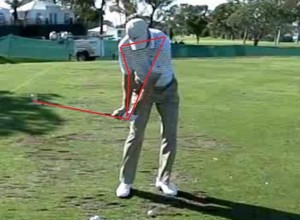
During the downswing, the swing arc has narrowed because the wrists are cocked and the right elbow is bent. The narrow arc stores energy that we release at impact. Keeping the wrists cocked until they enter the hitting area (below the waist) is called “holding the angle” for a “late release”.
These things create magic in the hitting area by releasing energy through the ball. The arc of the backswing is wide (the clubhead is relatively far from the body) because the arms are extended and the wrists have not yet cocked; on the way down, the arc narrows while the right arm is bent and the wrists are cocked—the club is much closer to the body during the downswing, similar to the way a figure-skater pulls her arms into her body to spin faster. The narrow arc stores energy which we unleash on the ball when the arc widens again at impact. Trying to hit a ball without narrowing the arc would be like jumping without first bending at the knees—it can be done, but it’s not likely to look very athletic, or produce a very impressive result (though you will still jump higher than most teaching professionals).
Timing is crucial when it comes to unleashing this energy—a “delayed” or “late” release refers to this good stuff happening in the hitting area (roughly the area below the waist), and not before. In fact a good, full release is most easily seen just after impact—both arms have gone to full extension; the clubhead is low; the shaft points right up the middle of the triangle formed by the arms and shoulders; the right arm and shoulder are lower than the left (for right-handed golfers); and the player’s weight has moved to the left foot, and probably toward the heel.
On the other hand, the term “casting” refers to releasing too early in the downswing by extending the arms and uncocking the wrists before entering the impact zone—the only benefit of this action is that you might dig up a few earthworms useful in sports where casting is a good thing. A powerful golf swing avoids casting, or early release, by going from wide, to narrow, and back to wide again at the right times.
I’ll leave it to somebody with a degree in physics to explain better, but it seems to me there’s a “synergistic” effect among the components of the release. It’s kind of like Kurt Cobain’s singing and Nirvana’s music; they are not much by themselves, but together they go platinum. Weight moving to the left, the arms accelerating to re-center with the body, the wrists and forearms uncocking and rotating the clubface into a fairly square position for impact—there’s something about these elements happening in unison that seems to produce a more exciting result than the sum of the individual parts normally would.
A blended, well-timed release allows us to unleash great force on the unsuspecting ball without feeling or looking like we made much of an effort—and I think this is a big part of the allure of the game for many people, seeing a ball occasionally and mysteriously fly higher and farther than expected. Delivering a full release is what makes elite players look so effortless while pounding the golf ball—even tour guys who look like they’d be found under “atrophy” rather than “athlete” in the dictionary. Charles Howell and Sean O’Hair for example; these guys could fit in their staff bags–and weigh less–but they really move the golf ball by tapping into the power of the release.

By impact the weight has moved to the left, the arms have swung back to the center of the body, the forearms have rotated the clubface to a fairly square position, and the wrists have uncocked. The hands are further left (ahead of the clubhead) than they were at address–this is a sign of the “late release” and this position usually accompanies a powerful strike on the ball.
So a good release stores and unleashes energy; its timing is crucial; the different pieces of the downswing have synergy when they come together in the impact zone; and this release has the potential to generate impressive force, even for those of us who look like our most athletic endeavor is internet surfing.
One more important thing to understand about the release of the golf swing: it happens very quickly and ideally without conscious effort. While a golfer can attempt to hit practice shots trying to feel a “late release” of the wrists, and the full extension just past the ball, I think it’s important to realize that a strong, natural release is more of a RESULT than an EFFORT. If we do certain things during the swing, and don’t do certain other things, the physics of the motion are in our favor for a good release of the arms, wrists, and club—the arc “wants” to widen as we rotate through the shot, it’s just a matter of letting it widen, and letting it widen at the right time. That’s why I say we “earn” the release rather than “create” or “force” the release.
So what’s the secret of elite players? How do they tap into this deep well of power while the rest of us feel bottled up? Or in my language, how do we “earn” such a release?
Some things make it tough to earn a good release.
Let’s start with a few common release-killers, things that make it difficult to earn the release, or nearly impossible to strike the ball well even if we do release the club well.
Poor planes: golfers who swing their arms or club in very steep angles will likely hit chunky shots and pulls if they make a good, low release of the hands and wrists; so they learn to come out of posture and lift the clubhead in the hitting area (which helps them avoid chunks and pulls, but also leads to weaker “picked” shots and often misses to the right).
The same thing would be true for someone whose first move in the transition is to turn the shoulders or swing the arms outward, toward the ball. Similar to this “over the top” move is starting the backswing with an outside or quick upward move of the left arm—a good release after this often leads to dreaded shanks.
On the other hand, very flat or inside-out planes (as in wrapping the club around the body during the backswing) tend to “discourage” the wrists from un-cocking and the forearms from rotating properly in the hitting area; as a result, golfers with these planes will hit a lot of thin shots and blocks unless they use a big muscular effort to re-route the club, or maybe “flip” the wrists laterally. Trying to force a release with muscular effort can be done, but rarely provides the same great shots as a free, natural, and fairly relaxed release.
Poor balance, or instability, is another big release-killer for many golfers. Every movement of the spine tends to change the shaft and clubface angles, usually in ways that make the release tough to achieve or pointless (again, because a good release with poor balance will produce poor shots). A lot of golfers lean toward the ball during the backswing or downswing (without realizing they do so)—then if they fully extend the arms and club at impact their best shots are chunky and pulled, while their worst shots peel off the neck in nauseating directions. Other golfers come out of posture early which usually means they have to release early, or cast the club, in order to “reach” the ball (and vice versa).
Poor tempo also makes it tough to store the energy of the backswing until we get back down to the ball. Sam Snead was known for his beautiful and powerful swing, and he claimed the swing was in Waltz-time or three-quarter time. A lot of good players swing like this—three parts backswing to one part downswing, and this tempo is important to the timing of the release. Imagine a fly fisherman: starting his rod down too abruptly results in a jumbled line, but the right cadence lets him throw his line an amazing distance across the river.
Essentially, when a golfer has planes or tempo that get too far off track, or a lot of excess body movement, he ends up with two main options: go ahead and fully release the club (if possible) and hit very poor golf shots; or avoid the power of a full release in favor of off-center, weaker, but more playable golf shots. It’s like having a gorgeous Lamborghini in the garage but you can’t handle a stick-shift—so you end up taking out the old rusty Taurus just to get along.
This second-best option is evident if you look at an average golfer just after impact: you’ll likely see some sort of flip, or bending of the wrists; the clubhead will be quickly passing the hands and ascending into the air; the left arm will be bent or chicken-winging; the right arm and shoulder will be rising quickly, possibly even going “over” the left arm and shoulder. All of these things suggest a weak or ill-timed release, and are the opposite of how elite players tend to look just after impact. But with a little practice, most people can learn how to drive a stick-shift and impress their buddies with the sleek power of the Lamborghini.
Some things help us to earn a full release.
Without trying to list all the variables that lead to a good release, I’ll mention a few things that generally help earn powerful positions at impact, starting with the setup.
At address, a bent, bouncy posture with the sternum slightly forward of the knees is helpful—a low and slightly forward center of gravity (knees flexed, weight in the balls of the feet) keeps the body more stable when the forces of the swing start acting. As a side-note, most players are able to hit great golf shots with the ball positioned well left of center in the stance as they get better at the timing and motions of a full release.
The address posture is also important because it gets the hands slightly away from the lap, making room for the left arm to move inside (away from the ball) during the takeaway, and the weight to load to the rear. As I mentioned above, the left arm and body moving toward the ball in the backswing makes a fully extended release perilous rather than pleasurable. Without wrapping the arms or club around the body in a flat plane, most golfers are able to make a much more aggressive move through the ball if they feel the left arm “pushing them back” as if pushing the sternum away from the ball early in the backswing.
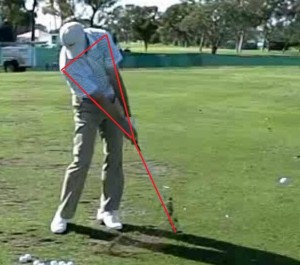
A full release is most obvious just after impact: the arms are fully extended with the right side lower than the left, and the clubhead is low with the shaft pointing close to the target line. This is a common position for elite players and a rare position for high-handicappers. Notice the lack of “flipping”, “chicken-winging”, or coming out of posture.
Another area of focus: lateral movement to the right tends to be destructive of the release, whereas a little lateral movement to the left tends to help (again, this is for right-handed golfers). Swaying or “sliding” the body to the right in the backswing makes it tougher to “compress” or solidly “trap” the ball without compensations, whereas a brief lateral move onto the left leg and hip to start the downswing has several benefits: it reduces a tendency to turn the shoulders outward or over-the-top to start the downswing, it helps the wrists stay cocked longer (“holding the angle for a late release”), and it allows the club to swing along the target-line longer.
The release also gets a boost by “sequencing” the downswing, or allowing the body to unwind from the ground up—the feet creating sheer forces against the ground as the legs and hips get the rest of the body unwinding with power. Most amateur golfers either turn the shoulders first, or turn everything together on the downswing—which tends to widen the arc early, creates less speed, and ruins the balance we need for a great impact position. When we “clear” the left hip by opening it to the target, our weight stays off the toes (a release-killer), and the motion becomes a sequential whip that accelerates the arms into the hitting area.
Most golfers could use this simplified image to power their swing: make a shoulder turn and wrist-set in the backswing to “store energy”, and use the lower body to initiate a downswing that releases that energy through the ball. Good sequencing often gives golfers a sense of “waiting” for the club to swing through the hitting area only after the lower body has pulled, and the action truly becomes a “swing” instead of a “hit”. Sequencing, partnered with good tempo, gives us a better chance of developing a strong release.
Golfers who use video to analyze their swings can look for a few more signs that they’re getting closer to those magical impact positions: it’s a sign of a late/powerful release if the head lowers slightly in the downswing (not toward the ball, though), and the hands are ahead of the clubhead at impact. Also, rather than a common tendency for the right heel to rise too much and too early, it would be better to see the toes of the left foot starting to rise slightly—meaning the weight is clearing to the left heel rather than toward the toes. The belt buckle turning toward the target well ahead of the chest will promote athletic sequencing and weight transfer. Finally, as a golfer starts to earn the release at impact he’ll start to look like it’s a golf ball in front of him instead of a snake: instead of jumping away with arms and wrists flapping as if to take flight, he will fully extend his arms while maintaining posture and a low clubhead, even after the iron tears a nice divot from the earth.
There could be a longer list of things to do (and not do) to set the stage for the kind of release we see on tour, but I have listed some of the main issues for average golfers. Working through these things at the driving range should help those of us who have embarked on a life-long journey in search of the secrets to great golf shots and lower scores. The beauty of earning a full release is that it provides a free, athletic, and powerful swing, but it also produces contact so pure it’s almost spiritual, followed by a penetrating, accurate ball flight. What else do we seek, we pilgrims of the game with the silly name?
Tip #4 Be Aware of Short-Game “Black Marks”
 The short game is crucial when it comes to scoring well in golf. We all know this. We’re told from the days when we first play how it all comes down to putting and chipping, and most of us know how it feels to get beat like a drum by some 80-year old father-in-law who can only hit the ball 150 yards from the tee, but who chips and putts like he sold his soul to the devil. Even when it comes to tour professionals, we recognize that the good putters and wedge players tend to show up on the money list.
But many golfers never fully discern the impact of short-game failures in their own games. Too many golfers relate success on the course to having a beautiful, fluid, powerful swing–and if they sense early in a round that the ball-striking is off, they often tend to check out of the round mentally, as if to say, “Well, there’s no way to score well with this kind of swing….”
Of course a good swing, and good ball-striking opens the door for good scoring, and takes pressure off the short-game (it’s generally a lot easier to score if we hit 13 greens instead of 8 greens in regulation), which introduces the “chicken or egg” discussion many golfers have about the way to lower their scores–if I hit straight, long drives and accurate irons, then I can score well, even if the short-game is not very sharp, right? On the other hand, a chipping and putting genius doesn’t need much accuracy or length in full shots, as displayed by many of the senior members at any club. The way a golfer prioritizes this long-game/short-game dilemma will largely determine his practice routine and his ability to improve over time.
As a teaching professional who has watched thousands of golfers struggle to conquer this game, I look at it like this: no matter how amazing a golfer’s swing and ball-striking, the full swing can never cover the sins of a terrible short-game (unless a golfer can routinely drive the green on par-4 holes, or hole shots from the fairway), but an amazing short game definitely has the possibility to cover the sins of a poor swing. Since scoring is defined by dropping the ball in the hole, and since dropping the ball in the hole almost always comes as a result of short-range shots, it’s only by reducing the number of short-range shots that most golfers can dramatically reduce their scores.
That’s why there are only two statistics I keep for myself, and that I consistently ask my clients to track. Score, and “black marks”. Black marks are my way of tracking the number of “extra” short-game shots in a round of golf and how they affect the final score. Here’s what a black mark is: any stroke taken after the second short-game shot, per hole. Basically, once you are approaching the green and have less than a full shot, the clock is ticking. You have two shots to hole the ball. Every shot after that is a short-game “black mark”. So, if you hit the green in regulation with a full shot, you have two putts to hole the ball without a black mark. If you miss the green, you have one chip or pitch, and one putt to hole the ball. If you get close to reaching a par-5 in two shots, you have to get up and down for birdie to avoid a black mark.
This sounds tough for most golfers, and unrealistic for high-handicappers, but the point is that the extra short-game shots are exactly the shots that make them high-handicappers. Even for beginners and people who play above double-bogey golf, generally 70-90% of their shots over par are black marks. They may not hit the ball very well, or far, and might lose some strokes by hitting a few shots out of play, but the fact remains that they generally reach the short-game zone in a reasonable number of shots and then take a pitch, a chip, and three putts to make their big number (three black marks on one hole!).
And as a golfer improves, the percentage of lost strokes that are black marks actually increases to 85-120% (meaning they could shoot under par by removing their black marks)! This is because a single-digit handicapper doesn’t lose too many balls, or hit too many out of bounds, so his lost shots tend to be failures to get up and down when he misses 6-8 greens per round, or doesn’t convert on reachable par-5′s.
A high handicapper will often average close to two black marks per hole (four total short-range shots per hole). This means if he shoots 108, he might have 32 black marks. In this case, 89% of his shots over par are black marks. If he cut them in half, he could shoot 92, and if he got rid of all of the black marks, he could shoot 76!
Personally, I might typically shoot 75 and have 6 black marks (despite the fact that the short-game could be considered my strength). This means that the rounds when my black marks disappear (which is very tough and rare) are under par, and possibly even in the 60′s.
If you want to have a full awareness of the short-game’s impact on your scoring, play several rounds and track your black marks. Take notice of how low your scores could be if you dropped almost all the black marks. And consider focusing your practice time and instruction on the parts of the game that will make the biggest difference to your scores!
Tip #3 The Simple Pitch
 The pitch is often the shot that the average golfer struggles with the most. It is also the shot that allows low-handicappers and pros to separate themselves from the field. In other words, the pitch is a shot that has the potential to make every golfer better.
Here are some thoughts to put the pitch into context:
1) The pitch is generally a fairly high trajectory shot, and we play it from short range when we need more fly than roll from the ball (over some rough and a sand trap to a pin on the close side of the green , for example). A chip is the opposite: we play it when we can roll the ball most of the way to the target.
2) The pitch is similar in technique to the full swing, and is mainly different from the chip in that we cock the wrists to create enough force to loft the ball. In rolling shots (putt and chip) we generally keep the hands and wrists quiet, whereas higher and longer shots (pitches and full shots) usually require setting the wrists to provide power.
3) There are many types of pitches, including the blast, flop, the low spinner, and the pitch and run. The average golfer should at least feel comfortable with a basic pitch, and then learn the others over time.
4) Pitching tends to be difficult for people because it has all the moving parts of a full swing, but adds a finesse element as we try to regulate the distance of the shot. The average player is generally better off putting and chipping the ball whenever possible.
Here are some of the most common problems that emerge when golfers attempt to pitch the ball:
1) Some golfers struggle with the pitch because they try to take distance off of their wedge shots by taking a fairly normal backswing and then decelerating as they approach impact. Contact usually suffers when we do this, and even if we make decent contact, the shot will likely go off line.
2) Many golfers try to control the shot too much with the arms, usually right from the start during the backswing. Creating a disconnect between the body and the arms makes the timing of contact difficult, and it often makes a player’s balance suffer too.
3) Just as it happens in chipping, many golfers fight the instinct to scoop or lift the ball when pitching; the tendency is even worse in pitching, though, because there is so much loft on the club-face and we know we need to get the ball air-born, so we try to “get under” the ball. Contact and distance control suffer greatly when we use the arms and hands to try to lift the ball off the ground. And if it’s not tough enough to resist the scooping instinct, a lot of us actually “need” to make a scooping or flipping move through the ball as a compensation for other swing failures.
4) As in all shots in golf, if we get off balance or out of plane during the swing, we will struggle to hit solid shots. The same is true in pitching.
Here are some thoughts about the setup and execution of a basic or simple pitch:
1) Set up fairly close to the ball, with an athletic posture and “soft”, bouncy knees. Consider moving the lead foot away from the target line a little as if “opening” the stance. This does three things: helps keep weight off the toes, clears the left hip out of the way for impact, and allows us to build a little bit of coil in the body even if we make a smaller than usual backswing.
2) Which wedge you choose and the ball position are variable based on the shot required: a more lofted club and the ball further forward for high pitches, and the opposite for lower pitches.
3) Feel a connection between the lead arm and the upper torso. Start the swing by turning the lead shoulder with the arm still connected; soon in the takeaway, cock the wrists in a fairly steep angle, forming a “letter L” between the lead arm and the shaft of the club. It’s important to let the lead arm swing at least a little to the inside even though it’s likely a short backswing because contact tends to suffer when the lead arm stays parallel to the target line. Unwind the swing through impact by smoothly turning the knees and belt buckle to face the target while shifting weight to the front foot. Allow the club to follow this action. Try to let the wrists un-cock and release naturally rather than using them to hit or lift the ball.
4) A few general thoughts: imagine having a wrist set in the backswing, but not in the follow-through (this helps to avoid lifting and scooping); avoid deceleration by thinking “short to big”, meaning a short backswing to an almost full follow-through; and imagine the tempo and balance of an easy side-arm toss to keep centered and rhythmic. Regulate the distance of the shot by adding shoulder turn and a little extra arm-swing to the backswing as necessary (or by changing the club).
5) Choose a club with more bounce, or open the face of a wedge to expose and increase the bounce, to help on shots from fluffy or furry lies (thick rough, soft-sanded bunkers, etc.) and to help avoid chunking these finesse shots.
Since the pitch is generally the toughest shot for golfers to conquer, it is also the shot that has the most potential to give golfers an advantage when they do become proficient at it. A good goal for any golfer would be to become very good at a simple pitch and then add various other pitching techniques to become a true short-game genius.
Tip #2 The Simple Chip and a Drill
 There are several kinds of chips and pitches in the game of golf, but every golfer should have a “simple chip” in his repertoire.
Here’s a couple thoughts to put the simple chip in context:
1) A chip is a low trajectory shot that results in the ball rolling more than it flies (a pitch is the opposite).
2) Since it is a low, running shot, the chip is similar in technique to a putt, whereas the pitch is closer in technique to the full swing since it flies more. As is true in putting, golfers tend to struggle more with the distance control of chips than the direction of their shots. Distance control in chipping is a matter of club selection, length of swing, consistency of contact, and PRACTICE.
3) The general rule for short-game shots is that we get the ball on the ground as soon as safely possible; so the chip is the shot of choice when the putter won’t work too well but we can still get the ball rolling most of the way.
4) We can chip with almost any club, but most chips are played with 7-iron and up through the set (the higher irons and wedges). We choose the club based on the fly/run ratio of the shot. The 7-iron will provide a lot of run after a relatively short amount of flying (a lie close to green-side with a pin far across the green for example), whereas a sand wedge will give almost an equal fly to run ratio (when used with a chip technique). A shot that requires more fly than run (again, because of something like thick grass or a bunker we cannot run through) is a pitch, not a chip.
5) The errors in chipping tend to be less dramatic than the mistakes in pitching, so we will choose to chip whenever possible; and the average golfer is often better off choosing a chip-style “bump and run” across the fairway even from as far out as 30-50 yards (if there are no obstructions) rather than trying a finesse pitch.
The simple chip earns its name because it reduces the technique to the most basic stroke we can use for most green-side shots.
Here’s what that means with a few thoughts about the execution of this shot:
1) To set up for a simple chip, choose the club that will give you the right amount of fly and then run, choke down on the grip to set up close to the ball and over the ball, similar to a putt. Place the ball slightly further back in the stance than usual, and then lean the head, sternum, and club toward the target. Moving the hands and handle toward the target at address tilts the face of the club downward slightly, which reduces the loft on the club.
2) The swing for the simple chip is similar to a putting stroke after taking this stance. Try to maintain the triangle formed by the arms and shoulders (no breaking of elbows). Connect the arms to the upper chest and use the shoulders to swing the arms and club as a unit. The tilt of the head and sternum toward the target should allow this motion to ascend in the backswing and then DESCEND through the ball.
3) In the simple chip there is no cocking of the hands or the wrists (though there are other chips with some hand action), but there might be a hint of hand rotation that softly opens the clubface and allows it to close again or “release” through impact.
4) Some of the most common problems that arise: trying to make the club move in too much of a straight line back and through (this causes contact and directional issues); ideally the club will move in a shallow arc around the feet. Hand and wrist action creates unnecessary moving parts and inconsistent ball-striking. And a lot of beginners really struggle with an instinct to lift or “scoop” the ball into the air–they do not realize that a DESCENDING blow with the little bit of loft on the club-face will loft the ball just the amount needed to get safely on the green and then run to the target.
5) It often helps people to drop the front foot back, away from the ball, which “clears” the hips out of the way and keeps the weight off the toes, which is a common reason for more scooping or lifting of the club through impact. Even on such a small, simple swing many golfers benefit from a small weight shift toward the heel of the front foot to initiate the forward swing.
6) ”Wristy” chippers often do well to arch their wrists toward the ground (like trying to point their thumbs directly at the ground); this helps “lock” the wrists so they can make the stroke with limited hand action.
Here’s a drill for golfers who struggle with the instict to make a chipping motion with a lot of hand and wrist action, usually because they want to lift or “scoop” the ball off the ground:
Take a good, tilted setup for the simple chip with something in front of you that you can chip under. A chair or bench might work, or a rope or string hung between two posts would do the job. Seeing the low angle of the shot required to go under the object will encourage a DESCENDING approach into the ball. The contact of such a chip will be much better and more consistent (which leads to distance control with some practice), and ironically the shot will often launch HIGHER than shots when you instinctively try to lift the ball.
Chipping and putting combined account for about half of all the shots played in a round of golf, so their execution is crucial for golfers who want to play and score well. The simple chip is a “must-have” shot for golfers of all ability levels.
Tip #1 Fringe Drill for Fine Putting
 Here are two facts about putting: most people do not aim their body and putter where they think they do; and most people struggle to properly read and adjust for the slope of the green. But here’s another fact: despite their problems getting aligned and playing the break (directional control), golfers generally miss the speed of the putt (distance control) with an error three to five time worse than their direction!
In other words, as bad as we tend to be when it comes to alignment and directional issues, we are much worse at controlling the speed or distance of our putts.
In the short-game, and especially putting, golfers see the greatest improvement by developing very good distance control. If I give an average player several putts to a hole, a definite pattern emerges–what I call the “cigar” pattern, or if there’s some break to the putt, the “banana” pattern. What the pattern shows is that the direction of the putts is pretty good, and very consistent. But the pattern is stretched out near to far, like a cigar or banana, suggesting the speed of the putts was not accurate or consistent.
To improve the distance control is to improve the putting, so I usually recommend the fringe drill for putting. By putting to the fringe line on the green with multiple balls, golfers become focused on the aspect of the putt they most need to improve–the speed. And they get the repetitions that help them develop “feel”.
I recommend doing this drill uphill and downhill, with long putts and short ones so that the golfer’s brain stores “data” about various putts, and how much swing it takes to stroke putts of various distances. My junior golfers play this as a game, earning three points each time the ball comes to rest on the fringe line, and one point each time the ball comes to rest on the first half of the fringe (no points for short putts, or excessively long putts).
Over time, as a golfer turns the cigar pattern into a more horizontal pattern, or a small circle around his target by controlling the speed of his putts, he will have fewer three-putts and see more putts fall after the first stroke.
The Whole Truth and Nothing but the Truth
A Review of Jim Hardy’s The Plane Truth for Golfers
January 13, 2010
One of the many funny things about golfers is that we tend to bring religious conviction to our swing techniques. “Thou shalt keep thine head down!” and a million other commandments come down from the mountaintops of golf wisdom. We talk about swinging the club “the right way” or “correctly”, we seek the “secret move” like the Holy Grail itself, and I have found that it is a rare golf conversation that does not include the word “perfect” somewhere along the way.
True to form for us messianic mashers of golf balls, the titles of the three golf books I have recently read each include one of the following words: perfect, truth, and laws. These are great words when we are dealing with commandments and our eternal souls, but are they really appropriate when working on a reverse spine angle in this silly game we play?
Putting in Perspective
The Often-Neglected Key to Good Golf
October 30, 2009
The putting stroke is the simplest of the swings we use in the game of golf, and it probably should be the starting point, the foundation on which a golfer builds his game. It is also true that the target in putting is a sassy, sometimes inaccessible hole in the ground which starts at 4 ¼ inches and seems to shrink as the ball gets closer, which means putting is difficult even if the stroke is relatively easy. On top of that, the putter will be the most used (and abused) stick in the bag, with the ability to determine on its own which way our scores go. So, why do we tend to neglect putting in lessons, and in our practice sessions? Read more
Creating a Swing With Tour-Like Beauty
June 26, 2005
Golfers often wonder how and why professional’s swings look so effortless. They wonder why their own swings look and feel so different. Instead of the fluid, quiet power of Ernie Els or Fred Couples, most amateurs have a swing that amounts to a patchwork of moving parts, compensations, and tension. So what makes the tour players’ swings so different? Read more
The President’s Cup Returns
Virginia Hosts the World’s Best Golfers
September 22, 2005
The President’s Cup returns to the Robert Trent Jones Club in Northern Virginia this week. The most prestigious golf event held in Virginia, the President’s Cup is a showdown between a team of top U.S. players and an International team. The twelve-man teams spar for the Cup every two years, and even though this is only the sixth playing of the tournament, it has become a symbol of great competition, drama, and goodwill in the world of golf.
The Robert Trent Jones Club (which is called “RTJ” by those of us who will work a lifetime to make the kind of money that members drop for initiation) has hosted every stateside President’s Cup since the first one in 1994. This is an exclusive, classy setting at Lake Manassas in Gainesville, Virginia. They do not call it “Gainesville”, though– in a sharp marketing effort, all of the advertising and literature generated by the tournament lists the location of RTJ as “Prince William County”. The imagery seems appropriate for such a majestic place. Read more
The Physical Challenge of Golf
The Search for Power and Accuracy
December 18, 2005
Hitting a golf ball well, or hitting a golf ball consistently well, has to be one of the most difficult things in the world of sports; maybe the most difficult thing. Most athletic endeavors put a premium on either power or finesse, either strength or accuracy. Golf’s full swing requires all of that and more. The challenge is that we have to use those warped sticks we call golf clubs not just to hit the ball a long ways, but to hit it to relatively small targets. Doing this well, and often, is a physical achievement equivalent to the high-speed movie antics of Jackie Chan. Read more
The Inside Scoop
About Golf Swings and Causal Relationships
February 10, 2005
Golf, like life, has a lot to do with causal relationships. Say what? Causal relationships; like when you tell your boss that you are late to work because your alarm did not go off. Of course, the direct cause for being late was that you overslept. Oversleeping was caused by the alarm failing to go off (and because you stayed up too late watching the golf channel). The alarm did not work because you forgot to pay the electric bill, which caused the electric company to cut off power to your house. So, in a roundabout way, you were late for work because you forgot to pay the electric bill. Causal relationships. Read more
A Beginner Again
The Teacher’s Turn to Struggle
January 29, 2006
I recently started fooling around with a keyboard. I say “fooling around” because it would not be accurate to say that I am playing music (at least by earthly standards) except when I deftly push the demo button and crank out selections from “Ave Maria” to “Camptown Races” with the greatest of ease. I started with the keyboard because I have this notion that it would be nice to play the piano someday. So far I have learned how far away someday is. Like the golfers I see daily, I am a beginner again, and it makes me remember how difficult it can be to learn a new skill. Read more
Winter in the Mid-Atlantic
Where Golfers Hope Against Hope
January 15, 2006
Golf in January, like everything else, is different in the Mid-Atlantic region. In this clump of misfit states stuck somewhere between New England and the Deep South, even the grass we grow on our golf courses is different. People who study such things call this a “transition zone”, which is a fancy way of saying that we have goofy weather and that only certain grasses prosper here—the kind of grasses nobody wants to play golf on. Go north of here and your spikes will tear up Bent grass. Go south and your ball gets buried in Bermuda. Read more
Are Your Golf Clubs Too Long?
Even if You Seek Distance it Might Be True
June 16, 2009
There is a good chance that your golf clubs are too long. Over the past twenty years, golf club manufacturers have been making clubs stronger (meaning they have less loft on the face), and longer so that they can sell hopeful golfers the newest “hot” weapon that will knock the ball unimaginable distances. But when golfers arrive at the driving range with long clubs, what I see is a lot of people with poor posture, inefficient shaft angles, awkward or mismatched swing planes, off-center contact with the ball, unhelpful trajectory, little accuracy, and none of the distance the long clubs were supposed to provide. Read more
Out of Posture
How to Avoid the Punch & Jump Combination
February 22, 2009
Many golfers suffer from the tendency to “peek”, “look up early”, “pick up the head”, or to “come out” of their shot, meaning their posture changes before they make contact with the ball. Most of the time this tendency results in a frustrating, “thin”, worm-burner of a golf shot when the club hits high on the ball—but confusingly, sometimes the shot is “fat” (hitting the ground before the ball) even though the body has practically gone airborne before impact. Read more
The Open at Pinehurst
The 105th U.S. Open
June 9, 2005
When golf fans tune into the major championships, like this week’s 105th U.S. Open at Pinehurst, they hope for major drama, something exciting enough to make them sit up in the lazy boy. They want to see unforgettable shots like Tiger’s amazing, hang-on-the-edge chip at the 16th hole during the final round of this year’s Masters. They want to see records broken, grueling head to head battles, and Cinderella stories. They want something to talk about around the water cooler on Monday, and to feel like it was worth skipping their own Sunday round (not to mention a few household chores) to park it in front of the television. Read more
The Pinehurst Trip
A Great Way to Start the Golf Season
February 17, 2005
It is February. That means slim green fingers, tulips to be, stretch out from soil softened by the sun after another night’s freeze, seeking Gulf moisture in the air and some warmth, which lingers a day or two before Canada gets blustery again and reminds us that there are still several weeks to winter. Read more
Taming the Beast of Tournament Golf
Preparing for Competitive Play
July 28, 2005
Tournament golf is no more like casual golf than bowling. That is a slight exaggeration, but it is what I tell my junior golfers when helping them prepare for the challenges of serious competition. It might be a better analogy to say that playing tournament golf is like playing golf with someone else’s body. Either way, the point remains that competing in golf tournaments is a completely different beast from playing the weekly match with the usual foursome. Read more
Talking Heads
Misconceptions About Keeping the Head Down
May 22, 2005
When it comes to the golf swing, one of the most talked about body parts is the head. The piece of advice that you hear repeatedly is, “Keep your head down.” This is golf’s equivalent of an apple a day to keep the doctor away. Unfortunately, a lot of the time this remedy is like taking cough syrup to treat a hangnail– it is nasty to take, and does not help the problem. Read more
Summer in the Shenandoah Valley
When the Middle Days Arrive
June 11, 2006
The Valley has been changing, and the daylight stretching out, as the solstice draws near. There is a fullness along the country roads where trees recently bare take on a middle-aged kind of thickness, swaying contentedly with the last of spring breezes. The cacophony of cicadas, tree frogs, crickets, and a million other mate-seeking critters makes such a steady droning that you actually have to think about it to hear their song. In the fields that twist to fit the Shenandoah River sit tawny bales of fresh-hewn hay which, from a distance, speckle the countryside like Civil War infantry frozen in time. Read more
Pinehurst Revisited
Another Great Trip to the Sand Hills of North Carolina
March 3, 2005
The Pinehurst Trip is over, and after a week down there, it seems to me that there is something almost enchanted, at least in a golf sense, about Pinehurst. It is a place of convergence, like the traffic circle just outside of the Village itself, and all roads in golf seem to lead to, or at least pass through, this place. It calls to golfers. Read more
The Fall Trip to Mount Mitchell
Where Men Become Boys
October 6, 2005
I have heard of these camps out west where men go for a week to rediscover their manhood, or release their inner child or something like that, by beating on drums and communing with nature. Some of the members at Lakeview do that too, but they go to North Carolina, beat on golf balls, and they call it the Fall Trip. Read more
Subcultures in Golf
This Game Takes all Types
November 17, 2005
Golf was once considered an elitist, old-man’s sport, a world where the only diversity was the hideous mixture of colors on the players’ plaid pants. But as things go in a relatively open and free society over time, golf has become accessible to almost everyone. The cookie-cutter country club types of yesteryear have had to make room for John and Jane Doe. And now there are subcultures within golf, different species of golfers, and the game has become a melting pot of personality types who are united only by their infatuation with herding little white balls into small holes with crooked sticks. Read more
Fix the Finish
Sometimes Function will Follow the Form
April 6, 2005
When working with a golfer to improve his swing, one of my favorite methods is to fix the finish. What that means is that we make the finish of the swing, the follow-through, look good. The golfer strikes a pose at the end of the swing, imagining, like I tell my junior golfers, that someone is taking a picture for Sports Illustrated. Read more
Going to Great Lengths
The Pursuit of Power in Perspective
July 3, 2005
Let’s face it, there are guys out there who would trade their first-born to hit the tee ball thirty yards farther. For some golfers, success is measured not by the number of strokes, but by the number of yards. It does not matter if the ball plugged in the greenside bunker, or if a double-bogey was the score, as long as I can tell my buddies later that I hit my driver 300 yards to get there. Read more
Patience is a Virtue in Every Language
Golf Lessons from Different Cultures
May 1, 2005
I have had the good fortune as a teaching professional to work with people from a variety of cultures. It is one of the best parts of my job, getting to meet so many interesting people from so many interesting places. And the one word I usually try to learn in different languages is patience. Read more
Plebeians Playing on Mount Olympus
Our Day at the Robert Trent Jones Club
April 2, 2006
We plebeians descended on the Robert Trent Jones Golf Club like a Mongolian horde. One of the perks of volunteering at the President’s Cup last fall was playing a round of golf at the stomping ground of the elite, so we charged the gates, ready for our day in the sun like the caddies taking over the pool at Bushwood. Read more
Praising Lakeview
A Scenic Best-Buy in the Shenandoah Valley
January 19, 2005
In the 1980s the economy boomed with real estate speculation, and developers built golf courses all over the place. In the 90s, the dot-coms were on fire and developers built golf courses all over the place. Those days of prosperity were celebrated with upscale daily- fee golf courses—open to the public, at least to people who are willing and able to pay $50-$100 to play golf. But in the days since 9/11, the stock market seems to be looking over its shoulder, and the golf industry has gotten a little soft. In times like this it is a good old, rural, inexpensive, take a pull cart, and grab a hot dog at the turn type of golf that appeals to people. Welcome to Lakeview Golf Club. Read more
Rejoining the Battle
A Game for Friends to Share
June 5, 2005
Gene and I started playing golf, or some bastardized slash-and-burn version of the game, when we were about fifteen or sixteen years old. I do not remember why we started playing. Gene was a baseball player; they called him Hoover, like the vacuum cleaner, because his long, gangly arms sucked up baseballs left and right before they could slip past the infield. I played basketball, which would have been a very short career with my height, or lack thereof, and my tectonic plate-like speed, but they instituted the three point shot while I played high school ball, and I was not afraid to launch the ball from the hash mark, or even half court, if given a chance. Read more
Relaxation Makes it a Swing
Develop Feel, Power, and Accuracy by Relaxing
May 7, 2006
It seems to be the instinct of most of us non-tour players to grip a club like we have gotten a hold of the neck of an IRS agent. It is like we are arm wrestling with the club—fingers, wrists, and forearms straining with our effort to hit that little ball higher, and straighter, and farther. But the tension in our swings is a big part of the reason we do not hit the ball more like tour players. Read more
Right Might be Wrong
Try Not to be Overly-Reliant on the Dominant Side
May 15, 2005
One common cause of swing problems is relying too much on the dominant side of the body. Because golfers sense their power and control from the dominant side, that is what they want to use. Unfortunately, the dominant side is usually the trailing side in a golf swing (the side farther from the target) and it causes all kinds of problems when it gets overly active. When a right-handed golfer relies on the right shoulder, arm, hand, and even the right leg to power his swing there will likely be some unappealing golf shots. Read more
Simplify the Swing
By Connecting the Arms and Body
October 13, 2005
One thing you never hear is that golf, or hitting a golf ball well, is easy. Sure, tour players sometimes make it look easy, but the elite golfers hit hundreds of thousands, even millions of balls during their careers to get that way. And most have coaches to make sure their practice focuses on things that actually make them better. Read more
Spring in the Shenandoah Valley
A Time and Place for New Beginnings
April 24, 2005
Spring wanders into the Shenandoah Valley like a vagrant, on no particular schedule, and likely to jump a ride out of town just when we get used to him being there. Technically, spring arrives around March 21 when the sun passes through the vernal equinox, whatever that means. Read more
About Junior Golf
Getting Kids Started in the Game
January 5, 2005
People frequently ask me about the best age to get their children started at playing golf. The easy answer is that it is not really a question of age, but of interest and attention span, which is obviously different from one child to the next. I have given lessons to children as young as three years old, but in general, it seems that young golfers respond better from age six and up. Read more
About the Yips
The Nature of a Nasty Stroke
July 16, 2006
Probably the most dreaded shot in golf is the shank. And the shank, which is when we hit the ball with the neck of the club rather than the clubface, unfortunately travels in herds. I will see a golfer at the driving range hit one or two of the ugly things, the ball squirting off at right angles to the target or rolling disgracefully twenty yards out, and next thing you know that is the only shot he can hit. But the strange thing is that the person in the next stall will start firing off those disgusting hosel-rockets too. Soon enough, half of the people at the range will inexplicably start peeling off shots in every direction and they will look around to see if anyone was watching, or they will glance accusingly at their clubhead as if their equipment suddenly malfunctioned. Read more
Fit to a Tee
Making the Most of the Winter Months
February 12, 2006
It is a slap in the face, the way CBS broadcasts these images into our homes. Less than twenty four hours after a foot of snow fell here in the east, we are taunted by the footage from the Monterey Peninsula where the tour players and a bunch of lucky amateurs are playing at Pebble Beach. Sunshine, sailboats, short-sleeve shirts, all kinds of exotic wildlife, that magnificent coastline where the Pacific pounds away—and here we are laid out in our egg chairs and lazy-boys after shoveling the driveway, two portable heaters breathing hot air towards a set of toes still unthawed. Read more
Firing on All Cylinders
Shifting Smoothly from Long to Short Clubs
March 17, 2005
One of the most common complaints I hear from golfers about their games, along with the usual desire for more consistency, is that they cannot seem to get the different kinds of golf shots to work at the same time. If they are hitting the tee ball well, then the irons are off the mark. If they are hitting the irons well, then the putter gets a little bulky. As a result, golfers can only dream about the scores they would shoot if all the pieces came together. Read more
Buying a Game
A Look at Golfer’s Priorities
October 13, 2006
In a world where golf club manufacturers daydream about things like coefficient of restitution and moment of inertia to make clubs that hit the ball farther and straighter; in a world where golf balls are engineered with two-piece construction and made of mysterious stuff like surlyn so that they fly unimaginable distances; in a world where people spend the equivalent of a college tuition to be properly outfitted for a round of golf; in a world where all this is true and yet the average male golfer shoots almost 100 and the average female shoots over 110—somebody needs to take a look at golfers’ priorities. Read more
Be a Match-Maker
Slingers and other Swingers Have to Find Compatibility
February 26, 2006
Good golf and good golf instruction are like all these new online dating services — they try to bring together things that are compatible. Golfers tend to think that there is a “perfect swing” or a “right way” to do it, and they spend their days trying to dig it out of the dirt, as Ben Hogan put it. In my mind, a swing is good if most of its components fit together. In other words, there are a lot of ways to skin the cat when it comes to hitting a golf ball; the trick is to make sure you are using only one way. Read more
Au Natural Again
How the Internet Restarted an Old Conversation
September 1, 2005
One thing I have learned since I started to write this column a little over a year ago: there is no such thing as a whisper when it comes to the internet. I find myself in the Kingdom of Google, where millions of net surfers have access to whatever tangle of words I might try to pass off as the gospel of golf. It can be daunting to imagine so many potential critics, but it also makes it possible to carry on a lot of interesting dialogues. Read more
Absolutely Great Putting
The Search for the “Right” Stroke
March 19, 2006
Until Tiger came on the scene, Jack Nicklaus was widely considered to be the best putter of all time, at least in terms of making a putt when it is needed the most. Nicklaus’ unique crouching stance, open alignment, and the resulting stroke make one thing clear about putting—it is not just about having “textbook” mechanics. No doubt Nicklaus’ putting stroke managed to satisfy the laws of physics or he would not have dropped so many putts during his incredible career; but what set Jack apart was his ability to make a great stroke despite the gremlins of fear and all the other demons of distraction that whisper in our ears when we pick up the flat stick. Read more
About Trajectory
An Angle for Every Occasion
October 28, 2005
Golf is a game of angles; lots of angles. There are shaft angles, spine angles, clubface angles, angles of approach, and many others, including launch angle, which basically determines the trajectory of a golf shot. “Trajectory” is a commonly used word in the world of golf, but it is also commonly misunderstood. Even when golfers know the meaning of the word, many fail to control the trajectory of their ball flight in a way that lets them get the most out of their shots. Read more
No Bones About It, It Was Ian’s Day
Ian Frazier’s Amazing Story
November 25, 2006
In a subtle, pleated-pants way, the game of golf has a tendency to create those transcendent moments when we feel larger than life, when we go beyond our personal limits. It is very rare, though, that achievements on the golf course rise to heroic. In my mind there is only a short list including Ben Hogan struggling to finish, yet winning, the 1950 U.S. Open just months after his legs were ravaged in a life-threatening car accident. But on a November day in Virginia Beach I witnessed something special. It was as if Ian Frazier rose up and wrestled with the fates, like Jacob taking on the angel of God. Read more
The Spiritual Side of Golf
This Game Sometimes Goes Beyond the Physical
December 15, 2004
What is it about golf that brings out the spiritual, almost mystical side in people?
I remember giving a lesson once with a tall, somewhat disheveled guy. We worked on his grip, posture, and alignment, and then I explained to him that when the setup is good, the ball, in a sense, is already at the target. The job of the swing is to let it stay there. The golfer got a far-off look in his eye and said, “Oh, man, that’s very Zen-like”. Read more
Golf and Fitness
Better Golf from a Better Body
December 8, 2004
Golf, for some of us, is no more athletic than folding laundry. Take a swipe, jump on a golf cart, drive over to the tree line on the right, kick the ball from under a cedar, a quick practice swing, take a rip, jump back in the cart, and head over to the left rough; keep repeating this routine until we get within three feet of the hole, consider it holed, and scoop the ball up with the back edge of the putter, and start over on the next tee. Read more
Learning the Game
Learning Alone Might Not Be the Way to Go
December 1, 2004
The young man, about sixteen years old, was a cart boy and snack bar attendant at a municipal golf course in Maryland. He had a mess of sandy blond hair, and an earnest look about him. He begged the club pro to come down to the driving range and help him with his swing. The young guy was a beginner. Read more
Winter Golf
When the Game Becomes Something Else
November 17, 2004
Welcome to winter golf. Technically, we are only half way through autumn, but golfers know that winter really starts when the clocks “fall back”. That is when the sun slinks away westward to the Alleghenies before the nine-to-fivers even punch out for the day; when the straightest drive can be lost among the thousands of noisy leaves that pepper the fairway. It is when the clubhouse gets crowded with retirees and shift-workers sipping coffee and telling stories while waiting for the morning rays to retake the greens from the frost that crept in under a cold crescent moon. This is when only true golfers remain. Read more
A Battle of High Principles
Is Golf a Game of Walking or Riding?
November 3, 2004
This will be the thirteenth time that the Walkers and Riders have knocked heads.
It all started in 1997, when Casey Martin, a tour player with a circulatory disease in his leg, sued the PGA for the right to use a golf cart in their tournaments. Late that year, a group of members from Lakeview Golf Club were sitting in Luigi’s restaurant nursing their own legs after a grueling hour of wallyball, which is volleyball played in a racquetball court. It is one of those things that golfers do when the days are too short for nine holes after work. Read more
Playing the Odds
Good Math on the Course Means Less Adding Later
October 20, 2004
Here is a common scenario on the golf course: Mr. Thinblader, a 30-handicapper, stands on the first tee with his Supercharged, 2000cc, Titanium Tomahawk driver, and takes an epic swing—which results in a ball mark two feet in front of the tee before the ball sheepishly grazes its way100 yards down the fairway. Now he has got about 240 yards left to the green, so he naturally picks out his matching 3-wood. He manages a pretty solid lick, which keeps the ball in play, about 35 yards short of the green. Then he blades the pitch across the green, chips back to the green, and two-putts for a double bogey. Read more
Kiss Three-Putts Goodbye
How to Learn Distance Control in Putting
October 27, 2004
“There is no point in taking a putting lesson,” I have heard people say. “It is an individual thing,” they say. While I agree that there are many different styles of putting that get results, there are also some underlying principles that help most people get better on the greens. And putting is such a crucial part of scoring in golf that it is better not left to random experimentation. Read more
Of Two Minds
Playing and Practicing Require Two Different Mental Approaches
October 13, 2004
Playing golf and practicing are two completely different parts of the game, with different goals and mindsets. For this reason golfers who try to play and practice at the same time are not really doing either. Read more
Patience is a Virtue
Game Improvement is a Long-Term Investment
October 5, 2004
In a world of fast food, DSL, and guaranteed overnight deliveries, improving the golf game can seem like a long and difficult process; especially when a golfer wants to turn his chunky pull-slice into a power draw with a one-hour lesson. Read more
The Long Ball
Distance Versus Course Management
September 29, 2004
I remember a story about Tommy Armour, the great player and golf teacher. Several members at his club turned their lounge talk into a significant wager on one of the prominent businessmen in the group-the question was whether this guy could break 90. One concession was made along with the bet: the businessman could take along Armour as his caddie and coach during the round. Read more

