
Earn the Release
By setting the stage for a great impact position
Golf comes with a strange language, starting with its name. Unlike sports with simple names like football, basketball, and baseball, our pastime sounds more like a dog spitting up a fur ball. I guess obvious names like “stickball” and “torture” were already taken when those bored and masochistic Scottish shepherds started chasing rocks across the links. And right behind its name, comes a train of quirky golf terms which are occasionally evocative, but often downright murky: we use things like wedges and hybrids and mallets, to make birdies and bogeys and divots, chips, lags, and duck-hooks (after a good waggle); sometimes we stray into the dark world of shanks and yips; but thank goodness our clubs have bounce, bulge, roll, offset, as well as various flexes, kick points, and torque or we’d never convince that wayward little ball to find its home.
Also in the messy melting pot of golf vocabulary we find the term “release”. This sounds like it ought to be a good thing, and it is. Release is what happens for elite players in the hitting area, just before impact and through the ball, and it is one of the biggest differences between tour players and the average Joe. But it’s not enough for average golfers to learn and mimic those magic positions—the truth is that most golfers would not strike the ball very well even if they released the arms, wrists, and club beautifully; their positions might look like Freddy Couples, but the contact is more likely to bring Freddy Krueger to mind. Great players “earn” a great release by setting the stage at address, in the backswing, and in the transition to the downswing.
What is “release”?
Before we talk about earning a great release, we better try to figure out what this term means. In one sense, release is about un-doing what we did in the backswing. Most people include the following in their backswing (not counting, but assuming shoulder turn, which lets the other parts work): weight transfer, arm-swing, forearm rotation, and wrist cocking. Golfers tend to add so many other shimmies, sways, and sashays to the swing that it starts to look like a cross between zumba and a one-man melee, but generally all we need for an effective backswing are the four things listed above. Reversing these things in the hitting area provides a release: the weight moving toward the target (at least temporarily), the arms re-centering to the body, the forearms rotating in the reverse direction, and the wrists uncocking.
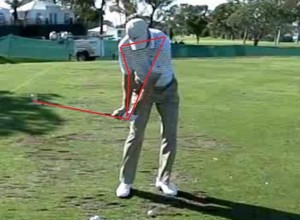
During the downswing, the swing arc has narrowed because the wrists are cocked and the right elbow is bent. The narrow arc stores energy that we release at impact. Keeping the wrists cocked until they enter the hitting area (below the waist) is called “holding the angle” for a “late release”.
These things create magic in the hitting area by releasing energy through the ball. The arc of the backswing is wide (the clubhead is relatively far from the body) because the arms are extended and the wrists have not yet cocked; on the way down, the arc narrows while the right arm is bent and the wrists are cocked—the club is much closer to the body during the downswing, similar to the way a figure-skater pulls her arms into her body to spin faster. The narrow arc stores energy which we unleash on the ball when the arc widens again at impact. Trying to hit a ball without narrowing the arc would be like jumping without first bending at the knees—it can be done, but it’s not likely to look very athletic, or produce a very impressive result (though you will still jump higher than most teaching professionals).
Timing is crucial when it comes to unleashing this energy—a “delayed” or “late” release refers to this good stuff happening in the hitting area (roughly the area below the waist), and not before. In fact a good, full release is most easily seen just after impact—both arms have gone to full extension; the clubhead is low; the shaft points right up the middle of the triangle formed by the arms and shoulders; the right arm and shoulder are lower than the left (for right-handed golfers); and the player’s weight has moved to the left foot, and probably toward the heel.
On the other hand, the term “casting” refers to releasing too early in the downswing by extending the arms and uncocking the wrists before entering the impact zone—the only benefit of this action is that you might dig up a few earthworms useful in sports where casting is a good thing. A powerful golf swing avoids casting, or early release, by going from wide, to narrow, and back to wide again at the right times.
I’ll leave it to somebody with a degree in physics to explain better, but it seems to me there’s a “synergistic” effect among the components of the release. It’s kind of like Kurt Cobain’s singing and Nirvana’s music; they are not much by themselves, but together they go platinum. Weight moving to the left, the arms accelerating to re-center with the body, the wrists and forearms uncocking and rotating the clubface into a fairly square position for impact—there’s something about these elements happening in unison that seems to produce a more exciting result than the sum of the individual parts normally would.
A blended, well-timed release allows us to unleash great force on the unsuspecting ball without feeling or looking like we made much of an effort—and I think this is a big part of the allure of the game for many people, seeing a ball occasionally and mysteriously fly higher and farther than expected. Delivering a full release is what makes elite players look so effortless while pounding the golf ball—even tour guys who look like they’d be found under “atrophy” rather than “athlete” in the dictionary. Charles Howell and Sean O’Hair for example; these guys could fit in their staff bags–and weigh less–but they really move the golf ball by tapping into the power of the release.

By impact the weight has moved to the left, the arms have swung back to the center of the body, the forearms have rotated the clubface to a fairly square position, and the wrists have uncocked. The hands are further left (ahead of the clubhead) than they were at address–this is a sign of the “late release” and this position usually accompanies a powerful strike on the ball.
So a good release stores and unleashes energy; its timing is crucial; the different pieces of the downswing have synergy when they come together in the impact zone; and this release has the potential to generate impressive force, even for those of us who look like our most athletic endeavor is internet surfing.
One more important thing to understand about the release of the golf swing: it happens very quickly and ideally without conscious effort. While a golfer can attempt to hit practice shots trying to feel a “late release” of the wrists, and the full extension just past the ball, I think it’s important to realize that a strong, natural release is more of a RESULT than an EFFORT. If we do certain things during the swing, and don’t do certain other things, the physics of the motion are in our favor for a good release of the arms, wrists, and club—the arc “wants” to widen as we rotate through the shot, it’s just a matter of letting it widen, and letting it widen at the right time. That’s why I say we “earn” the release rather than “create” or “force” the release.
So what’s the secret of elite players? How do they tap into this deep well of power while the rest of us feel bottled up? Or in my language, how do we “earn” such a release?
Some things make it tough to earn a good release.
Let’s start with a few common release-killers, things that make it difficult to earn the release, or nearly impossible to strike the ball well even if we do release the club well.
Poor planes: golfers who swing their arms or club in very steep angles will likely hit chunky shots and pulls if they make a good, low release of the hands and wrists; so they learn to come out of posture and lift the clubhead in the hitting area (which helps them avoid chunks and pulls, but also leads to weaker “picked” shots and often misses to the right).
The same thing would be true for someone whose first move in the transition is to turn the shoulders or swing the arms outward, toward the ball. Similar to this “over the top” move is starting the backswing with an outside or quick upward move of the left arm—a good release after this often leads to dreaded shanks.
On the other hand, very flat or inside-out planes (as in wrapping the club around the body during the backswing) tend to “discourage” the wrists from un-cocking and the forearms from rotating properly in the hitting area; as a result, golfers with these planes will hit a lot of thin shots and blocks unless they use a big muscular effort to re-route the club, or maybe “flip” the wrists laterally. Trying to force a release with muscular effort can be done, but rarely provides the same great shots as a free, natural, and fairly relaxed release.
Poor balance, or instability, is another big release-killer for many golfers. Every movement of the spine tends to change the shaft and clubface angles, usually in ways that make the release tough to achieve or pointless (again, because a good release with poor balance will produce poor shots). A lot of golfers lean toward the ball during the backswing or downswing (without realizing they do so)—then if they fully extend the arms and club at impact their best shots are chunky and pulled, while their worst shots peel off the neck in nauseating directions. Other golfers come out of posture early which usually means they have to release early, or cast the club, in order to “reach” the ball (and vice versa).
Poor tempo also makes it tough to store the energy of the backswing until we get back down to the ball. Sam Snead was known for his beautiful and powerful swing, and he claimed the swing was in Waltz-time or three-quarter time. A lot of good players swing like this—three parts backswing to one part downswing, and this tempo is important to the timing of the release. Imagine a fly fisherman: starting his rod down too abruptly results in a jumbled line, but the right cadence lets him throw his line an amazing distance across the river.
Essentially, when a golfer has planes or tempo that get too far off track, or a lot of excess body movement, he ends up with two main options: go ahead and fully release the club (if possible) and hit very poor golf shots; or avoid the power of a full release in favor of off-center, weaker, but more playable golf shots. It’s like having a gorgeous Lamborghini in the garage but you can’t handle a stick-shift—so you end up taking out the old rusty Taurus just to get along.
This second-best option is evident if you look at an average golfer just after impact: you’ll likely see some sort of flip, or bending of the wrists; the clubhead will be quickly passing the hands and ascending into the air; the left arm will be bent or chicken-winging; the right arm and shoulder will be rising quickly, possibly even going “over” the left arm and shoulder. All of these things suggest a weak or ill-timed release, and are the opposite of how elite players tend to look just after impact. But with a little practice, most people can learn how to drive a stick-shift and impress their buddies with the sleek power of the Lamborghini.
Some things help us to earn a full release.
Without trying to list all the variables that lead to a good release, I’ll mention a few things that generally help earn powerful positions at impact, starting with the setup.
At address, a bent, bouncy posture with the sternum slightly forward of the knees is helpful—a low and slightly forward center of gravity (knees flexed, weight in the balls of the feet) keeps the body more stable when the forces of the swing start acting. As a side-note, most players are able to hit great golf shots with the ball positioned well left of center in the stance as they get better at the timing and motions of a full release.
The address posture is also important because it gets the hands slightly away from the lap, making room for the left arm to move inside (away from the ball) during the takeaway, and the weight to load to the rear. As I mentioned above, the left arm and body moving toward the ball in the backswing makes a fully extended release perilous rather than pleasurable. Without wrapping the arms or club around the body in a flat plane, most golfers are able to make a much more aggressive move through the ball if they feel the left arm “pushing them back” as if pushing the sternum away from the ball early in the backswing.
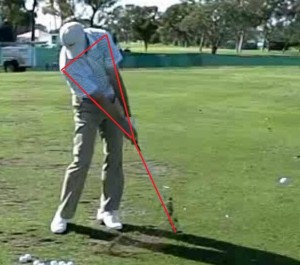
A full release is most obvious just after impact: the arms are fully extended with the right side lower than the left, and the clubhead is low with the shaft pointing close to the target line. This is a common position for elite players and a rare position for high-handicappers. Notice the lack of “flipping”, “chicken-winging”, or coming out of posture.
Another area of focus: lateral movement to the right tends to be destructive of the release, whereas a little lateral movement to the left tends to help (again, this is for right-handed golfers). Swaying or “sliding” the body to the right in the backswing makes it tougher to “compress” or solidly “trap” the ball without compensations, whereas a brief lateral move onto the left leg and hip to start the downswing has several benefits: it reduces a tendency to turn the shoulders outward or over-the-top to start the downswing, it helps the wrists stay cocked longer (“holding the angle for a late release”), and it allows the club to swing along the target-line longer.
The release also gets a boost by “sequencing” the downswing, or allowing the body to unwind from the ground up—the feet creating sheer forces against the ground as the legs and hips get the rest of the body unwinding with power. Most amateur golfers either turn the shoulders first, or turn everything together on the downswing—which tends to widen the arc early, creates less speed, and ruins the balance we need for a great impact position. When we “clear” the left hip by opening it to the target, our weight stays off the toes (a release-killer), and the motion becomes a sequential whip that accelerates the arms into the hitting area.
Most golfers could use this simplified image to power their swing: make a shoulder turn and wrist-set in the backswing to “store energy”, and use the lower body to initiate a downswing that releases that energy through the ball. Good sequencing often gives golfers a sense of “waiting” for the club to swing through the hitting area only after the lower body has pulled, and the action truly becomes a “swing” instead of a “hit”. Sequencing, partnered with good tempo, gives us a better chance of developing a strong release.
Golfers who use video to analyze their swings can look for a few more signs that they’re getting closer to those magical impact positions: it’s a sign of a late/powerful release if the head lowers slightly in the downswing (not toward the ball, though), and the hands are ahead of the clubhead at impact. Also, rather than a common tendency for the right heel to rise too much and too early, it would be better to see the toes of the left foot starting to rise slightly—meaning the weight is clearing to the left heel rather than toward the toes. The belt buckle turning toward the target well ahead of the chest will promote athletic sequencing and weight transfer. Finally, as a golfer starts to earn the release at impact he’ll start to look like it’s a golf ball in front of him instead of a snake: instead of jumping away with arms and wrists flapping as if to take flight, he will fully extend his arms while maintaining posture and a low clubhead, even after the iron tears a nice divot from the earth.
There could be a longer list of things to do (and not do) to set the stage for the kind of release we see on tour, but I have listed some of the main issues for average golfers. Working through these things at the driving range should help those of us who have embarked on a life-long journey in search of the secrets to great golf shots and lower scores. The beauty of earning a full release is that it provides a free, athletic, and powerful swing, but it also produces contact so pure it’s almost spiritual, followed by a penetrating, accurate ball flight. What else do we seek, we pilgrims of the game with the silly name?
Golf and Fitness
Better Golf from a Better Body
December 8, 2004
Golf, for some of us, is no more athletic than folding laundry. Take a swipe, jump on a golf cart, drive over to the tree line on the right, kick the ball from under a cedar, a quick practice swing, take a rip, jump back in the cart, and head over to the left rough; keep repeating this routine until we get within three feet of the hole, consider it holed, and scoop the ball up with the back edge of the putter, and start over on the next tee. Read more
GTC Columns
Tip Sheet Columns


